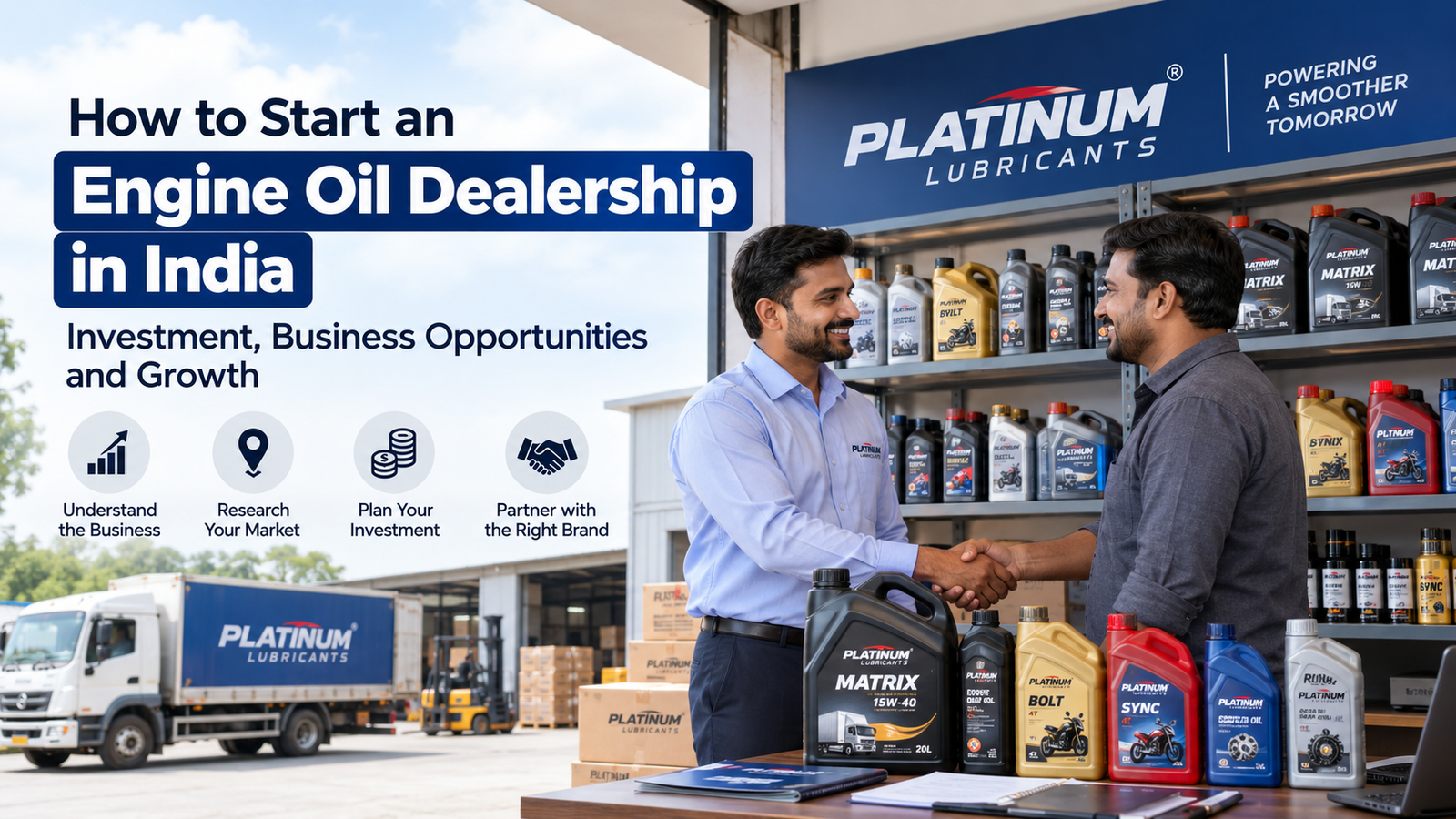
Starting an engine oil dealership in India can be an opportunity for entrepreneurs looking to enter the automotive aftermarket. Engine oils, gear oils, greases and other lubricants are used across motorcycles, passenger vehicles, trucks, agricultural machinery and industrial equipment.
For aspiring entrepreneurs, the opportunity lies not just in selling lubricant products but in building relationships with mechanics, automobile workshops, spare-parts retailers, fleet operators and local distributors.
However, starting a successful engine oil dealership requires more than finding a supplier and purchasing stock. You need to understand your local market, select the right product portfolio, manage working capital and develop a reliable customer network.
In this guide, we explain how to start an engine oil dealership in India, what factors to consider before investing, how to select a lubricant brand and how to build a sustainable distribution business.
1. Understand How the Engine Oil Dealership Business Works
Before investing in an engine oil dealership, it is important to understand the different business models available.
Engine oil retailer
A retailer purchases lubricants from a distributor or wholesaler and sells them to individual customers, mechanics and local workshops.
This model may suit entrepreneurs who already operate an automobile spare-parts shop, garage or automotive accessories store.
Engine oil wholesaler
A wholesaler purchases products in larger quantities and supplies them to smaller retailers, mechanics, workshops and other trade customers.
This model generally requires more working capital, storage capacity and an established network of buyers.
Lubricant distributor
A distributor typically manages product supply across an assigned territory, depending on the manufacturer's distribution policy. Responsibilities may include developing retailer relationships, maintaining inventory, coordinating deliveries and expanding local market coverage.
Some manufacturers may offer dealership, distributorship or other trade-partner arrangements with different commercial terms.
Which model should you choose?
Your decision should depend on your available capital, existing customer relationships, preferred territory, storage arrangements and experience in automotive sales.
If you are already operating a spare-parts shop or have strong connections with mechanics, a retail dealership may be a practical starting point. If you have an established trade network and the resources to manage larger inventories, a wholesale or distribution model may be worth evaluating.
2. Research Your Local Market Before Investing
One of the most important steps in starting an engine oil dealership is identifying who will buy your products.
Do not select a brand or purchase large quantities of stock before understanding local demand.
Start by researching the following customer segments.
Motorcycle and scooter workshops
Two-wheeler service centres and independent mechanics regularly interact with customers who need engine oil and related maintenance products.
Research the brands they currently sell, the grades they stock, their purchasing frequency and the factors that influence their buying decisions.
Automobile spare-parts retailers
Spare-parts shops can provide access to vehicle owners, mechanics and repair businesses. Speak with existing retailers to understand their preferred suppliers, product availability requirements and expectations from a new lubricant brand.
Commercial vehicle workshops and fleet operators
Truck and bus workshops, transport businesses and fleet operators may require heavy-duty diesel engine oils, gear oils and greases.
Their buying decisions may depend on product specifications, vehicle-manufacturer recommendations, supply reliability, price and documented product performance.
Agricultural and industrial customers
Depending on your territory and product portfolio, you may also explore tractor workshops, agricultural equipment dealers, factories and industrial maintenance contractors.
These customers can have different lubricant requirements from motorcycle workshops or passenger-vehicle retailers.
Practical tip: Visit at least 20–30 potential trade customers before making a significant investment. Ask what they currently purchase, what problems they face with suppliers and what would make them consider an additional brand.
This is a suggested market-validation exercise, not a guarantee that a particular number of visits will establish demand.
3. How Much Investment Is Required to Start an Engine Oil Dealership?
There is no single investment amount that applies to every engine oil dealership in India.
Your total investment will depend on whether you operate from an existing shop, rent a warehouse, sell directly to retailers or distribute products across a wider territory.
Consider the following cost categories before preparing your business budget.
| Investment category | What to consider |
|---|---|
| Initial inventory | Product varieties, pack sizes and opening stock requirements |
| Premises and storage | Shop rent, warehouse rent, deposits and storage arrangements |
| Working capital | Cash required to replenish stock and manage payment cycles |
| Transportation | Delivery costs, loading, handling and local distribution |
| Marketing | Signboards, product catalogues, retailer outreach and promotional materials |
| Business administration | Registration, accounting, invoicing and other applicable compliance costs |
| Emergency reserve | Unexpected expenses and short-term cash-flow requirements |
Before committing funds, request a written commercial proposal from the lubricant manufacturer or distributor.
Clarify the minimum opening order, payment terms, applicable taxes, freight charges, any security deposit, territory arrangements and stock-replenishment process.
Avoid basing your decision on a headline investment figure without understanding what it includes.
4. How to Choose the Right Engine Oil Brand for Your Dealership
Your supplier can significantly influence your dealership's ability to serve customers consistently.
A brand with a broad product range may help you serve multiple customer segments, but product availability alone is not enough. You should also evaluate quality documentation, commercial terms and the manufacturer's ability to support your business.
Consider these factors when comparing lubricant brands.
Product range
Check whether the manufacturer offers products relevant to your local market, including two-wheeler engine oils, heavy-duty diesel engine oils, gear oils, hydraulic oils, greases and other specialty lubricants.
A suitable range can help you serve different customer groups without purchasing products that have little demand in your territory.
Product specifications and documentation
Ask for technical data sheets, applicable performance specifications, product documentation and information about quality-control procedures.
Make sure you understand which applications each product is intended for. Never recommend an oil solely because its viscosity grade appears similar to another product.
Supply reliability
Ask how orders are placed, what lead times to expect, how stock availability is managed and how shortages or damaged shipments are handled.
Reliable replenishment is particularly important when retailers depend on you for regular supplies.
Dealer margins and commercial terms
Request the actual price list and understand the difference between purchase discounts, gross margin and net profit.
Calculate your expected earnings after freight, delivery, credit costs, discounts, damaged stock and operating expenses.
Do not assume that a high advertised margin automatically translates into high profitability.
Marketing and sales support
Ask whether the manufacturer provides product catalogues, technical training, branding materials, promotional support or assistance with developing local trade relationships.
Such support can be useful when introducing a relatively unfamiliar lubricant brand to mechanics and retailers.
5. How to Become an Engine Oil Distributor in India
If you want to become an authorised lubricant distributor, follow a structured process.
Step 1: Define your target territory.
Identify the city, district or region you want to serve. Estimate the number of potential retailers, workshops and other trade customers in that area.
Step 2: Assess your business readiness.
Prepare information about your existing business, customer network, storage arrangements, delivery capability and available working capital.
Step 3: Shortlist manufacturers.
Compare product portfolios, technical documentation, pricing, supply reliability, commercial policies and the support available to distribution partners.
Step 4: Request the distributor terms.
Before placing an order, clarify territory rights, opening stock, payment terms, minimum purchase commitments, returns policy and any sales expectations.
Step 5: Submit your dealership enquiry.
Contact the manufacturer through its official website or sales team. Provide accurate business details and explain the territory and product categories you are interested in.
Step 6: Review the agreement and plan your launch.
Once the terms are agreed, establish an initial customer list, plan inventory, prepare a delivery process and schedule visits to potential retailers and workshops.
A careful onboarding process can help you avoid committing too much capital before you understand your market.
6. How to Find Customers for Your Engine Oil Dealership
After securing a supplier, your next challenge is building a consistent customer base.
Develop relationships with mechanics
Mechanics influence lubricant selection and can be important sources of repeat demand.
Visit workshops, introduce your product range, provide accurate technical information and maintain reliable stock availability. Build relationships through service and trust rather than making unsupported product-performance claims.
Build a retailer network
Create a list of spare-parts shops, automobile accessory stores and lubricant retailers within your territory.
Record their product requirements, current suppliers, purchasing frequency and preferred ordering method. Follow up systematically and make ordering convenient.
Approach commercial fleets
If your portfolio includes suitable heavy-duty lubricants, approach transport operators, fleet maintenance teams and commercial vehicle workshops.
Understand their vehicle requirements and maintenance practices before proposing products. Provide the relevant technical documentation and commercial quotation.
Use local digital marketing
Create a professional business profile where eligible, maintain accurate contact details and use WhatsApp Business for product catalogues and customer communication.
A simple website or landing page can also help customers discover your business when searching for lubricant suppliers in their area.
Focus on repeat orders
Track which customers purchase regularly, which products sell fastest and which accounts need follow-up.
Repeat orders, dependable delivery and good customer relationships can be more valuable than acquiring a large number of one-time buyers.
7. Common Mistakes to Avoid
New lubricant dealers can face avoidable challenges when they invest before validating their market.
Buying too much inventory: Start with products supported by customer demand and supplier guidance. Avoid tying up working capital in slow-moving stock.
Choosing a brand based only on price: Evaluate product documentation, customer acceptance, supply reliability and the complete commercial proposition.
Ignoring payment cycles: Sales on credit can create cash-flow pressure even when reported sales are growing. Establish clear credit limits and collection procedures.
Assuming guaranteed profits: Actual profitability depends on purchase costs, selling prices, expenses, inventory turnover, competition and customer payment behaviour.
Neglecting customer relationships: A dealership requires ongoing selling, order fulfilment and follow-up. Opening stock alone does not create a sustainable business.
Ignoring applicable requirements: Confirm the registrations, tax obligations, invoicing requirements and storage or safety rules relevant to your specific business model.
8. Is an Engine Oil Dealership Right for You?
An engine oil dealership may be worth exploring if you understand your local automotive market, can develop trade relationships and have the financial discipline to manage inventory and receivables.
It may be particularly relevant to existing spare-parts retailers, automotive entrepreneurs, wholesalers and people with established relationships across workshops or commercial vehicle businesses.
Before investing, prepare a basic financial projection using actual supplier quotations and realistic sales assumptions.
Estimate your monthly sales, gross margin, operating expenses, stock turnover, credit period and expected cash requirements. Then calculate the sales volume needed to cover your operating costs.
This exercise will help you assess whether the proposed dealership fits your resources and business goals.
9. Explore a Dealership Opportunity with Platinum Lubricants
If you are evaluating lubricant dealership opportunities, Platinum Lubricants, the brand presented by Neelam Chemicals, offers a range of automotive and industrial lubricant products.
Its catalogue includes the Matrix range of heavy-duty diesel engine oils, Bolt and Sync two-wheeler oils, gear oils, hydraulic oils, greases and other lubricant products.
The company also has a dedicated dealer and distributor application page describing its partner programme, product range, supply proposition and marketing support.
If you are interested in becoming a dealer or distributor, review the available information and submit an enquiry to discuss your location, business background, preferred product categories and commercial requirements.
Explore the opportunity here: Become a Platinum Lubricants Dealer or Distributor
You can also explore the Platinum Lubricants product range to understand the products available.
Contact the company to confirm current territory availability, investment requirements, dealer pricing, margins, opening stock and applicable terms before making a business commitment.
Frequently Asked Questions
1. How do I start an engine oil dealership in India?
Research local demand, select a suitable business model, compare lubricant manufacturers, assess your investment and working-capital needs, and agree on the supplier's commercial terms before purchasing inventory.
2. How much investment is required for an engine oil distributorship?
Investment varies by territory, business model, opening stock, premises, logistics and supplier requirements. Obtain an actual quotation and prepare a budget before deciding how much capital to commit.
3. Is an engine oil dealership suitable for beginners?
It can be suitable for beginners who understand their local market, are prepared to develop customer relationships and can manage inventory and cash flow. Starting with validated demand is generally more prudent than purchasing a large quantity of stock immediately.
4. How can I become a lubricant distributor?
Identify the manufacturers you want to work with, assess their products and commercial terms, prepare your business details and apply through their official dealer or distributor enquiry process.
5. Which customers should an engine oil dealer target?
Potential customers include mechanics, two-wheeler workshops, spare-parts retailers, commercial vehicle workshops, fleet operators, agricultural equipment dealers and industrial buyers. Prioritise the segments that match your product range and territory.
6. How can I evaluate the profitability of a lubricant dealership?
Review actual purchase and selling prices, gross margins, transport costs, operating expenses, inventory turnover, credit losses and repeat-order potential. Calculate your break-even sales volume rather than relying on advertised profit estimates.
7. How do I apply for a Platinum Lubricants dealership?
Visit the official Platinum Lubricants distributor application page, provide your business and location details, and contact the company to confirm current commercial terms and availability.
Final takeaway: Building a successful engine oil dealership is about choosing the right products, understanding local demand, maintaining reliable supply and developing lasting trade relationships. Validate the opportunity with real customer conversations and supplier quotations before making a significant investment.