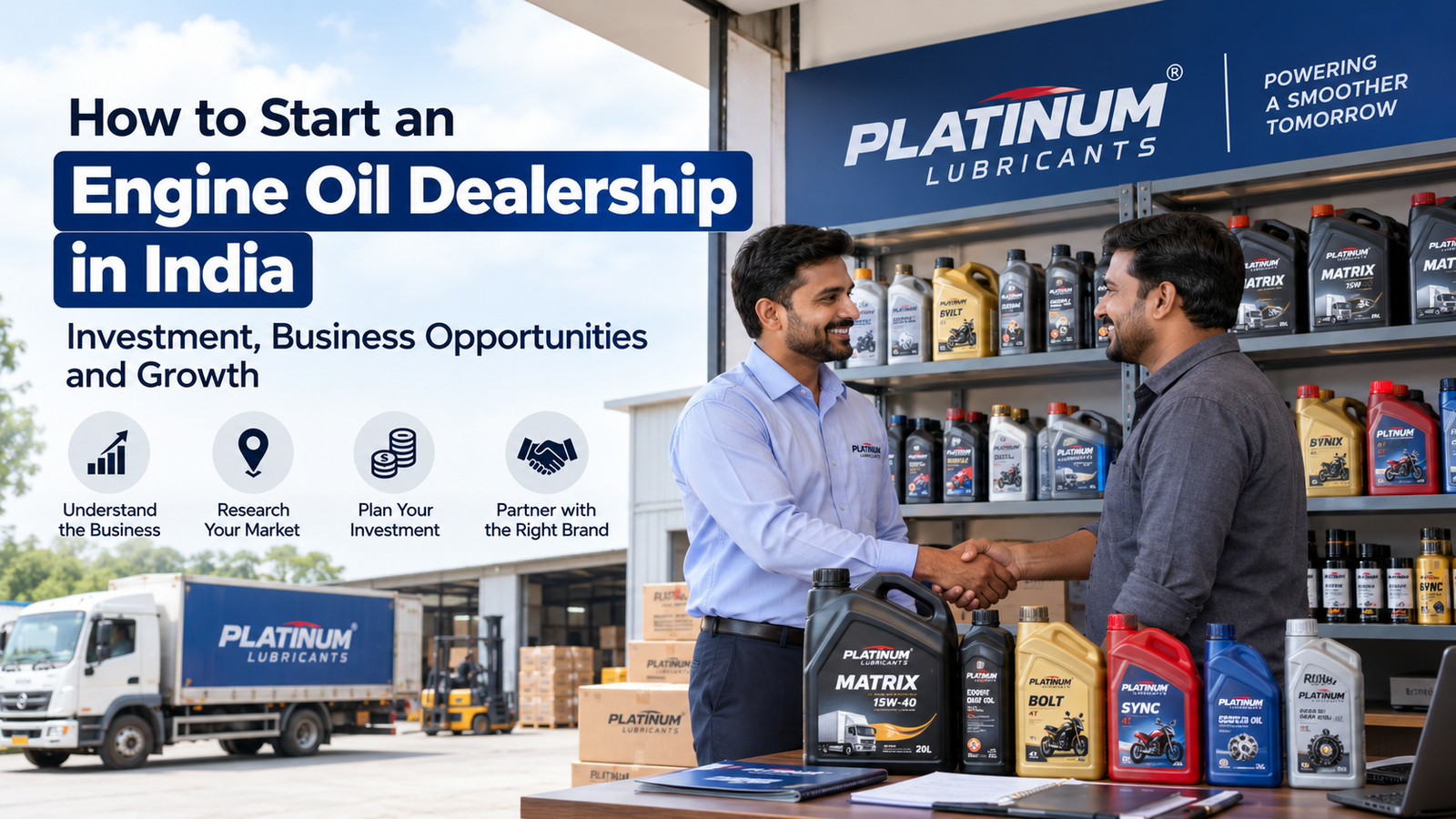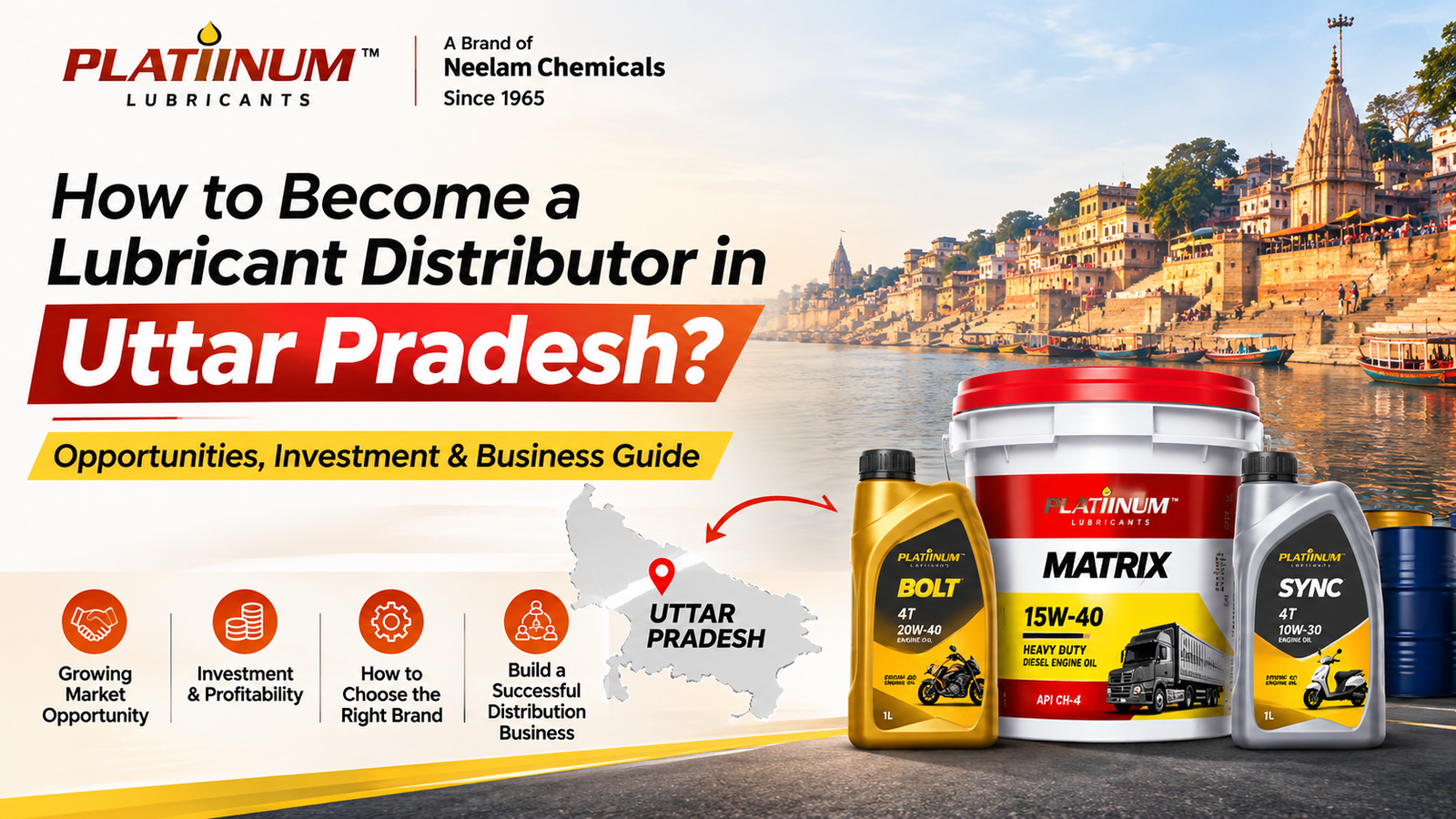
The automotive industry in Uttar Pradesh creates business opportunities for entrepreneurs interested in automotive spare parts, engine oils, industrial lubricants and vehicle maintenance products.
From motorcycle workshops and automobile spare-parts retailers to commercial vehicle operators and industrial businesses, lubricants are essential products across multiple customer segments.
For entrepreneurs looking to enter this market, becoming a lubricant distributor can be an opportunity to build a long-term B2B business by supplying quality products to retailers, mechanics, workshops and other trade customers.
But how do you become a lubricant distributor in Uttar Pradesh? What investment should you consider? How do you select the right lubricant manufacturer?
This guide explains the important steps involved in starting a lubricant distribution business in Uttar Pradesh.
1. Understand the Lubricant Distribution Business
Before becoming a distributor, understand how the lubricant supply chain works.
A typical lubricant distribution network involves three levels:
Manufacturer
A lubricant manufacturer produces engine oils, gear oils, hydraulic oils, greases and other lubrication products. Manufacturers supply products directly to distributors or through authorised distribution channels.
Distributor
A distributor purchases products from manufacturers and supplies them to retailers, wholesalers, automobile workshops and other customers within an assigned territory, depending on the manufacturer's distribution policy.
Retailer and Workshop
Retailers, automobile spare-parts shops and mechanics sell or recommend lubricants to vehicle owners and businesses.
As a distributor, your responsibility is to maintain product availability, develop a local customer network, manage inventory and ensure timely product delivery.
2. Why Consider a Lubricant Distribution Business in Uttar Pradesh?
Uttar Pradesh has a diverse automotive and commercial transportation ecosystem.
Different customer segments create demand for different categories of lubricants.
Two-wheeler workshops: Motorcycle and scooter service centres regularly require engine oils for routine servicing.
Three-wheeler operators: Auto-rickshaws and commercial three-wheelers require suitable engine oils and maintenance products.
Commercial vehicle businesses: Truck operators, transport companies and bus workshops require heavy-duty diesel engine oils, gear oils and related lubricants.
Agricultural equipment: Tractor workshops and agricultural machinery service providers represent another potential customer segment.
Industrial businesses: Manufacturing facilities and industrial maintenance teams require hydraulic oils, industrial lubricants and greases.
A distributor should identify which customer segments are most relevant to their location rather than attempting to serve every market immediately.
3. Which Cities in Uttar Pradesh Can You Target?
Your distribution territory should be selected based on customer density, existing competition, logistics and the availability of suitable business partners.
Some locations worth researching include:
Gorakhpur
Gorakhpur can be a potential base for entrepreneurs interested in serving automobile workshops, spare-parts retailers, commercial vehicle operators and surrounding districts.
Nearby markets to investigate include Deoria, Kushinagar, Maharajganj and Basti.
Lucknow
Lucknow offers access to automobile service centres, spare-parts retailers, commercial vehicle businesses and industrial customers.
Kanpur
Kanpur has an established industrial and commercial ecosystem. Entrepreneurs can investigate opportunities among industrial buyers, transport operators and automotive businesses.
Varanasi
Varanasi and nearby markets can be explored for two-wheeler workshops, automobile retailers, commercial vehicle businesses and regional distribution opportunities.
Prayagraj
Prayagraj provides another market to investigate for lubricant retailers, mechanics, automobile workshops and commercial vehicle customers.
Important: These are potential markets for business research, not confirmed vacant distribution territories. Always verify territory availability with the manufacturer before making an investment.
4. How Much Investment Is Required to Become a Lubricant Distributor?
The investment required depends on your business model, territory, product portfolio and opening stock requirements.
There is no universal investment amount applicable to every lubricant distributorship.
Before starting, consider the following expenses:
| Investment component | What it covers |
|---|---|
| Initial inventory | Opening stock of different lubricant categories |
| Warehouse | Storage space and applicable rental expenses |
| Working capital | Stock replenishment and payment cycles |
| Transportation | Delivery vehicles, fuel and logistics |
| Marketing | Retailer acquisition and promotional activities |
| Administration | Accounting, invoicing and business operations |
| Emergency reserve | Unexpected expenses and cash-flow requirements |
Before committing funds, request a commercial proposal from the manufacturer.
Clarify the minimum opening order, security deposit if applicable, payment terms, distributor margins, transportation costs and any territory-related conditions.
A detailed financial calculation is more useful than relying on general investment estimates.
5. How to Choose the Right Lubricant Manufacturer?
Selecting the right manufacturer is one of the most important decisions in building a lubricant distribution business.
Your supplier influences product availability, customer satisfaction, pricing and your ability to develop long-term trade relationships.
Evaluate manufacturers using the following criteria.
Product portfolio
Choose a manufacturer offering products that match the requirements of your target customers.
Depending on your market, this may include:
Two-wheeler engine oils
Three and four-wheeler engine oils
Heavy-duty diesel engine oils
Gear and transmission oils
Hydraulic oils
Automotive and industrial greases
Coolants and specialty lubricants
Product quality and technical specifications
Review product specifications, technical data sheets, applicable API classifications, viscosity grades and quality-control procedures.
The products should have clear application information so that retailers and mechanics can recommend suitable lubricants.
Manufacturing capabilities
Understand the manufacturer's production capacity, quality testing facilities, packaging capabilities and stock availability.
Consistent product supply is important when serving a network of retailers and workshops.
Distributor support
Ask whether the manufacturer provides product training, marketing materials, promotional assistance, technical information and support for developing the local market.
Commercial terms
Evaluate purchase prices, dealer margins, payment terms, minimum orders, credit policies and transportation arrangements.
Always calculate your expected net profitability after operating expenses.
6. How to Become an Authorised Lubricant Distributor?
If you are planning to become an authorised lubricant distributor in Uttar Pradesh, follow these steps.
Step 1: Identify your target market
Select the city or district where you want to operate. Research automobile workshops, spare-parts shops, retailers and commercial vehicle businesses.
Step 2: Evaluate your business capabilities
Assess your available capital, storage arrangements, existing customer network, transportation facilities and experience in sales or distribution.
Step 3: Shortlist lubricant manufacturers
Compare manufacturers based on their product portfolio, quality standards, commercial terms and distribution support.
Step 4: Contact the manufacturer
Submit a business enquiry with your preferred territory, business background, investment capacity and product interests.
Step 5: Understand the commercial agreement
Discuss distributor margins, opening stock, territory arrangements, payment conditions, order requirements and other applicable terms.
Step 6: Develop your distribution network
Once the commercial arrangement is finalised, identify retailers, workshops and other potential customers. Build a structured sales and delivery process.
Do not purchase substantial inventory until you have understood the manufacturer's terms and assessed the demand in your target market.
7. How to Find Customers for Your Lubricant Distribution Business
Finding customers is just as important as selecting a manufacturer.
Your long-term business performance depends on building a reliable network of repeat buyers.
Build relationships with automobile mechanics
Mechanics influence lubricant purchasing decisions. Visit workshops, introduce your product portfolio and provide accurate technical information.
Connect with spare-parts retailers
Prepare a list of automobile spare-parts shops and lubricant retailers within your territory.
Understand their existing brands, purchasing frequency, price expectations and supply requirements.
Approach transport businesses
Commercial vehicle operators and fleet maintenance businesses can be potential customers for suitable heavy-duty diesel engine oils and related products.
Develop local marketing
Use WhatsApp Business, product catalogues, local business directories and digital marketing to make your products accessible to potential customers.
Maintain consistent follow-ups
Track enquiries, customer purchases, pending payments and repeat-order requirements.
A distributor who maintains reliable stock and develops strong customer relationships has a better foundation for sustainable business growth.
8. Common Mistakes to Avoid When Starting a Lubricant Distributorship
Before investing, understand some common business challenges.
Purchasing excessive inventory: Avoid purchasing products without understanding their local demand and sales potential.
Choosing a manufacturer only on price: Evaluate quality documentation, product acceptance, supply reliability and commercial support.
Ignoring working capital: Credit sales and delayed payments can create cash-flow problems.
Expanding too quickly: Build a stable customer network before expanding into additional districts.
Not understanding product specifications: Different vehicles and machinery require different lubricant specifications. Product recommendations should always follow manufacturer requirements.
Ignoring customer retention: Regular communication, reliable delivery and consistent service help build long-term trade relationships.
9. Explore Lubricant Distribution Opportunities with Platinum Lubricants
If you are looking for a lubricant manufacturer to work with, explore the dealership and distribution opportunities offered by Platinum Lubricants, a brand of Neelam Chemicals.
Established in 1965, Platinum Lubricants has more than six decades of experience in lubricant manufacturing.
The company manufactures a range of automotive and industrial lubricants, including:
Matrix Heavy Duty Diesel Engine Oils – Engine oils for commercial vehicles, trucks and diesel engines.
Bolt and Sync Two-Wheeler Engine Oils – Lubricants for motorcycles and scooters.
Three and Four-Wheeler Engine Oils – Lubricants for passenger vehicles and three-wheelers.
Gear and Transmission Oils – Products for automotive and transmission applications.
Hydraulic Oils – Lubricants for hydraulic systems and machinery.
Automotive and Industrial Greases – Grease products for automotive and industrial applications.
Coolants and Specialty Lubricants – Products for vehicle cooling and specialised applications.
Explore the complete Platinum Lubricants Product Catalogue to understand the available product range.
With its manufacturing facility in Gorakhpur, Uttar Pradesh, the company serves customers across different automotive and industrial segments.
Platinum Lubricants aims to build long-term relationships with dealers and distributors through its product portfolio, manufacturing capabilities and partner network.
Whether you are an existing lubricant wholesaler, automobile spare-parts retailer or entrepreneur exploring a new distribution business, you can contact the company to discuss potential partnership opportunities.
Interested in becoming a Platinum Lubricants distributor?
Visit the official website to explore the product portfolio and submit your business enquiry.
Contact the company to understand current territory availability, investment requirements, opening stock, distributor margins and applicable commercial terms.
Frequently Asked Questions (FAQs)
1. How can I become a lubricant distributor in Uttar Pradesh?
Identify your target territory, research potential customers, shortlist lubricant manufacturers and submit a distributor enquiry. Discuss investment, opening stock, margins and commercial terms before signing an agreement.
2. What investment is required to start a lubricant distribution business?
Investment depends on opening inventory, warehouse requirements, transportation, working capital and manufacturer-specific requirements. Request an actual commercial quotation before preparing your budget.
3. Which lubricant products should a new distributor stock?
This depends on local demand. Common categories to investigate include motorcycle engine oils, three-wheeler oils, heavy-duty diesel engine oils, gear oils, hydraulic oils and greases.
4. Can I become a lubricant distributor in Gorakhpur?
You can explore opportunities in Gorakhpur by researching local retailers, mechanics, workshops and commercial vehicle businesses. Contact manufacturers to understand whether a suitable distribution arrangement is available for your territory.
5. What is the difference between a lubricant dealer and a distributor?
A dealer generally purchases products for resale to end customers or local businesses. A distributor typically handles larger-scale product supply and develops a network of retailers and trade customers within an assigned territory. Actual responsibilities vary by manufacturer.
6. How do I choose a reliable engine oil manufacturer?
Evaluate manufacturing experience, product specifications, quality-control processes, product range, supply reliability, pricing and distributor support.
7. Does Platinum Lubricants offer dealership and distribution opportunities?
Platinum Lubricants welcomes enquiries from prospective dealers and distributors. Contact Neelam Chemicals through its official website to discuss territory availability and current commercial requirements.
Final Thoughts
Starting a lubricant distribution business requires more than selecting a product and purchasing stock. It involves understanding your local market, selecting a reliable manufacturer, managing working capital and building a dependable customer network.
With proper market research and a structured business approach, entrepreneurs can explore opportunities in Uttar Pradesh's automotive and industrial lubricant markets.
If you are planning to enter this industry, start by evaluating your target territory and speaking with manufacturers about their distribution programmes.